Watch the video about tuna fisheries ruining the local environment in Papua New Guinea (PNG), and then sign the petition at Save the Rainforest.
Thursday, October 15, 2009


Tuesday, October 13, 2009
Coal pollution goes from air to water
 In a long article yesterday in the New York Times, Cleansing the Air at the Expense of Waterways, Charles Duhigg writes about how coal pollution is being moved from scrubbed smokestacks to waterways.
So three years ago, when Allegheny Energy decided to install scrubbers to clean the plant’s air emissions, environmentalists were overjoyed. The technology would spray water and chemicals through the plant’s chimneys, trapping more than 150,000 tons of pollutants each year before they escaped into the sky.I have to quote Gwen Ifill on this one: "What were they thinking?" Who in their right mind would authorize this pollution dump? Regulators are looking the other way, it seems. We spent so much energy fighting water pollution for years, but now that environmentalists' attention has turned to energy, there is apparently less attention being paid to the pollution of energy, other than its airborn effects.
But the cleaner air has come at a cost. Each day since the equipment was switched on in June, the company has dumped tens of thousands of gallons of wastewater containing chemicals from the scrubbing process into the Monongahela River, which provides drinking water to 350,000 people and flows into Pittsburgh, 40 miles to the north.
Yet no federal regulations specifically govern the disposal of power plant discharges into waterways or landfills. Some regulators have used laws like the Clean Water Act to combat such pollution. But those laws can prove inadequate, say regulators, because they do not mandate limits on the most dangerous chemicals in power plant waste, like arsenic and lead.Although the plant in the picture in Hatfield’s Ferry, PA, claims to have used high tech methods to remove toxic materials, which it then is hoarding in a lagoon with an impermeable membrane,
The plant’s water treatment facility ... does not remove all dissolved metals and chemicals, many of which go into the river, executives concede. An analysis of records from other plants with scrubbers indicates that such wastewater often contains high concentrations of dissolved arsenic, barium, boron, iron, manganese, cadmium, magnesium and other heavy metals that have been shown to contribute to cancer, organ failures and other diseases. Company officials say the emissions by the plant will not pose health risks, because they will be diluted in the river. (My italics)But the toxics go down river - to Pittsburg, into the Ohio, the Mississippi and ultimately the Gulf, which is already suffering from toxic runoff from mid-western farms.
Obviously the only solution is to ban coal. But it won't be easy, of course.
In 2000, Environmental Protection Agency officials tried to issue stricter controls on power plant waste. But a lobbying campaign by the coal and power industries, as well as public officials in 13 states, blocked the effort. In 2008 alone, according to campaign finance reports, power companies donated $20 million to the political campaigns of federal lawmakers, almost evenly divided between Democrats and Republicans.In my humble opinion, the coal industry should be using that money to clean up its act. Or required clean-up measures should be so high, that the costs of its externalities get added to the cost of burning coal. Coal is only cheap today because the coal and energy companies are letting others pay for their pollution, as cancer, asthma, toxic groundwater, dead and ruined waterways, etc. etc.. At some point, their lobby money won't work anymore. When you get too outrageous, even your paid loyalists will turn against you.
This is just one more reason to move to renewables as soon as possible!
Friday, October 2, 2009
Thursday, October 1, 2009
There are still mountaintops being removed
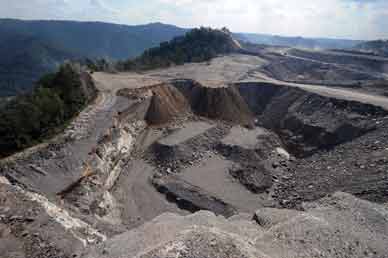 Just because the EPA has declared that all pending mountaintop removal projects are in violation of the Clean Water Act and must be reviewed further doesn't mean mountaintop removal is vanquished. For one thing, the projects are being reviewed with the companies to see if there is an acceptable solution; they aren't canceled. For the other, there are lots of permits being used right now. The Nation has an article by Jeff Biggers about The Coalfield Uprising which tells a lot more. Here's a short quote:
For the past few years, ever since a massive twenty-story dragline landed on a ridge near their home, the Webbs had endured twice-daily, bone-rattling explosions and the quasi-apocalyptic storms of coal dust and fly rock that blanketed their home and garden. Lindytown's creeks and mountain hollows no longer exist, and a once-thriving community has been reduced to a ghost town. "It's unreal. It's like we're living in a war zone," Lora Webb told a local newspaper last fall.Recently they gave up and sold their ancestral home to the mining company, Massey Energy, and were given 60 days to get out.
The temporarily homeless Webbs are a stark example that mountaintop removal does more than "likely cause water quality impacts," as the EPA has determined. More than 3.5 million pounds of explosives rip daily across the ridges and historic mountain communities in West Virginia; a similar amount of explosives are employed in eastern Kentucky, southwestern Virginia and eastern Tennessee. Mountaintop removal operations have destroyed more than 500 mountains and 1.2 million acres of forest in our nation's oldest and most diverse range, and jammed more than 1,200 miles of streams with mining waste.Let us hope that the EPA finally puts a complete stop on those new projects, and begins to look at the old ones as well.
Saturday, September 12, 2009
Thank you, Lisa Jackson!
Not only has the EPA under Lisa Jackson's guidance stopped Mountaintop removal at one site in West Viginia as reported in the previous post, but all 79 permits submitted by the Army Corps of Engineers have been returned, stamped Likely to violate the Clean Water Act. According to the Sierra Club newsletter I received today, this is not necessarily the end of MTR.
Now the Army Corps has 60 days to review and revise their proposals, and we expect coal companies to spend this time pulling out all the stops in attacks on the EPA. King Coal will say and do anything they can to get away with as they try to reverse this decision.They ask that you send a note of thanks to Lisa Jackson, head of the EPA, but ask her to work toward laws that will forbid this entirely.
Friday's announcement is a stark reminder that the coal industry is the beneficiary of loopholes that no other industry enjoys. It is time to close these loopholes, protect public health, and return the rule of law not just to Appalachia, but to all of America. It's time to end the hideous practice of mountaintop removal coal mining once and for all.
If you'd like to read more about this decision, try Jeff Bigger's article in the Nation Magazine: EPA Turns the Lights on Mountaintop Removal that reminds us that these reversals are just related to Clear Water Act issues, not life-style, community, and nature preservation. That will take entirely different laws, which, according to the article, are slowly working their way through Congress.
The news came as a bit of a surprise to some coalfield activists. "Since January we've been skeptical about how serious the new administration would be about addressing mountaintop removal," said Teri Blanton of Kentuckians for the Commonwealth, a citizens' organization in the state where more than half of the designated permits are located. "It looks like EPA is prepared to do everything it can, within the existing regulatory framework, to protect the mountains and people of Appalachia. This is great news, but it will take more than regulations to end the destruction. Mountaintop removal and valley fills should be banned."Many activists welcomed the announcement but, like Blanton, pledged to keep pushing legislators until the practice is abolished. Judy Bonds, co-director of Coal River Mountain Watch, said, "We will continue our fight for a total, complete reprieve for our children and for our beloved mountains and streams."
So we can't relax yet, but at least we know that these 79 mountains can breathe easier for a while longer.
Tuesday, September 8, 2009
Great News! EPA saves WVA mountaintop
 All those petitions must have made a difference! The EPA this weekend decided to reject applications for mountaintop removal mining in West Virginia, saying that there is "clear evidence" that environmental damage would occur if they were permitted. According to Ken Ward Jr.'s blog EPA moves to block W.Va.'s largest mining permit for the Charleston, WVA, Gazette:
William E. Early, acting regional EPA administrator, recommended the corps conduct a new environmental impact study of the permit proposal to evaluate "new information and circumstances" and "recent data and analyses" of mountaintop removal.I hope this is the beginning of the end of all 57 permits the EPA has on its board.
In a five-page letter, Early cited the Spruce Mine's "potential to degrade downstream water quality," the need for the company to give "serious consideration" to reducing valley fill size, and scientific studies that show mine operators cannot effectively replace the environmental functions of streams buried by mining waste.
If you want to know more about mountaintop removal, I recommend the blog quoted here: MiningtheMountains. For example, Coal's costs outweigh benefits, WVU study finds or Coal lawyer visits future mine site
Monday, September 7, 2009
Good News, but need your help

I've been receiving information recently from several sources about mountaintop removal. Evidently the EPA has requests for 86 mountaintop removal permits to go review here in September. The Rainforest Action Network asks you to sign this petition to Lisa Jackson of the EPA to go to Appalachia and view the destruction before she reviews the requests. As they write:
We're still on the precipice of disaster. In September, the Environmental Protection Agency (EPA) will review 86 new mountaintop removal permits. If approved, these 86 new permits could mean 86 less mountains in Appalachia. That spells disaster as mountaintop removal coal mining has already destroyed 500 mountains, buried 2,000 miles of rivers and streams under rubble and greatly harmed Appalachian communities and culture. If approved, these permits will be devastating for the people and ecosystems of West Virginia, Kentucky, Tennessee and other parts of Appalachia and authorize a new round of blasting, flooding, and water contamination.Lisa Jackson discussed the Energy Bill in an NPR interview September 3 on the Diane Rehm show, including a section on Mountaintop Removal (about 16 minutes into the interview) where she admitted that she didn't quite know that this is all about. The decisions on this is based on the Clean Water Act, which she says is the only area the EPA can act on. She admits that there are other issues, besides landscape and social issues. She equate this with coal mining in Wyoming, although the issue is very different, since the coal-mining area in Wyoming is not where people have lived, worked, hunted and fished for generations.
Siohban Hughes, writing in The Wall Street Journal of September 3, EPA to Soon Decide on Mountaintop-Mining Permits reported on the NPR interview with Lisa Jackson.
She said the EPA is reviewing about 84 such permits, deciding whether to block the permits from being issued. The U.S. Army Corps of Engineers issues the permits, though the EPA has veto power.Ohio Citizen Action reports on the NPR show with Lisa Jackson, pointing out that she admitted that she'd never seen a mountaintop removal site.
Mountaintop mining involves using explosives to blast off the tops off mountains in order to get at coal seams under the surface. The technique has become increasingly common -- surface mining operations in central Appalachia account for about 10% of U.S. coal production. But the EPA says that streams have been contaminated in the process and some forest lands have been destroyed.
"U.S. EPA Administrator Lisa Jackson found herself struggling to explain the Obama Admininstration's policy on mountaintop removal coal mining yesterday on National Public Radio's Diane Rehm Show. In response to questions from Ohio Citizen Action's Kate Russell and Guest Host Susan Page, Jackson said "we should uphold science" and agreed with Russell that the scientific research shows that mountaintop removal sites could not be reclaimed. She could not, however, state what the Obama policy on mountaintop removal is."Fortunately, there is also some good news (also from the Rainforest Action Network:)
"At one point it was not clear that Jackson understood what mountaintop removal coal mining was. Jackson said she had never seen a mountaintop removal site: "I have not yet seen it with my own eyes." Then she compared mountaintop removal first to strip mining and then to mining methods in Wyoming, neither of which are comparable," Paul Ryder, Organizing Director, Ohio Citizen Action.
Last Monday, it was announced that after a grassroots pressure campaign state-owned utility Santee Cooper is canceling its plans to build a $1.25 billion coal plant on the banks of the Great Pee Dee River in South Carolina. On Tuesday, two activists courageously climbed 80 foot trees to prevent mining company Massey Energy's mountaintop removal operations from raining debris and destruction on the Coal River Valley in southern West Virginia. Truly effective grassroots action has proven that Big Coal can be stopped in its tracks if we put our minds to it.
Subscribe to:
Posts (Atom)


 Posts
Posts


